Elena Cone
The Satanic VersesElena Cone is the deceased elder sister of Alleluia Cone, remembered both for her striking confidence and for the unresolved grief her early death left behind. She seemed to move through London as if it belonged to her; after her death, however, magazine images reduced that forceful presence to a reproducible fashion image. The contrast shapes Alleluia’s memories of Elena and her own later, perilous search for exaltation.
Identity and Family
Elena grew up in a family marked by her father Otto Cone’s determined effort to remake its identity. Otto Anglicized the family name, rejected reminders of his Polish past, and presented himself as English, while Elena’s mother, Alicja Cohen, later returned to the Cohen name and to Jewish religious and family customs. Elena’s father imagined an exceptional future for Alleluia, perhaps as a concert pianist or a Muse, and judged Elena disappointing because, in his view, she had desires where she ought to have had ideas. His expectations help frame the sisters’ difference: Elena’s confidence was vivid and worldly, but it did not match the intellectual ideal he imposed.
Elena’s presence was formidable from an early age. At six feet tall, she carried herself with an assurance that made her seem to claim the city as her own element. Fashion amplified that presence: she appeared in striking clothes, including a golden chain-mail design, and treated London not as a place to pass through but as a medium in which she could move freely. Alleluia, by contrast, remembered feeling inadequate beside her sister and uncertain of her own place in the world.
Sisterhood and Conflict
Elena tried to remake her younger sister’s appearance, urging Alleluia to stop hiding her looks beneath practical clothes. She dressed her in revealing fashion and took her to a gaming club. Alleluia left while Elena’s attention was elsewhere, unable to accept being displayed in the way her sister proposed. The episode exposed a difference in temperament: Elena presented sexual display as confidence and self-knowledge, while Alleluia experienced it as an unwanted performance.
Their conflict sharpened when Alleluia later told Elena that she was no longer a virgin. Elena responded with anger and condemned her sister’s sexual choices, drawing on attitudes Alleluia understood her to have inherited from Otto. The sisters saw sexuality through opposing codes: Elena guarded her own value by insisting on sexual inaccessibility, while Alleluia’s life moved in the opposite direction. They met little after this rupture. Elena remained a virgin, as the post-mortem later confirmed, while Alleluia continued into a very different adult life. The estrangement left their closeness unsettled rather than reconciled.
Death and the Afterlife of the Image
Elena died at twenty-one, with psychotropic drugs involved, in a bathtub. Alleluia first learned of her sister’s death from a sensational newsstand billboard. The headline’s pun struck her before grief did; she found that she could not weep. That first numb response did not mean Elena had vanished from her thoughts. For months, magazine stories and fashion spreads continued to feature Elena because of their long publication lead times, placing her image in settings far removed from the life she had lived.
Alleluia began drawing moustaches on the pictures and tearing them from magazines. She came to understand those repeated images as a kind of captivity: Elena seemed fixed forever in glossy poses, altered by advertising and fashion into an object that could neither answer nor move. This imagined posthumous torment became so powerful that Alleluia avoided shops where the pictures appeared, stopped opening magazines, and hid the photographs she owned. In addressing Elena’s memory by her childhood name, she finally acknowledged that she had to look away. The response joins mourning to a critique of the image’s afterlife: the magazines preserved Elena’s appearance while making that appearance feel less like her.
Memory, Risk, and Exaltation
Elena’s story returns when Gibreel Farishta finds her photograph inside Alleluia’s long-unopened copy of The Marriage of Heaven and Hell. He reads from the book and hands her the picture; Alleluia asks him to put it back. The photograph reveals how memory had been physically kept inside a book, alongside Alleluia’s old annotations, including a note dating creation to 4004 BC and estimating the apocalypse for 1996. Elena’s image is not simply an illustration of the past: its sudden reappearance reopens a grief Alleluia has tried to contain.
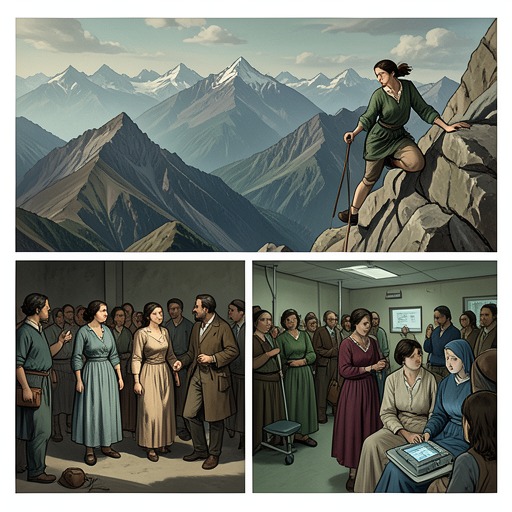
Alleluia also comes to see a likeness between her sister’s search for heights and her own. Elena had spent her brain’s resources pursuing sensation and the possibility of flight; years later, Alleluia risked herself in mountaineering, eventually climbing Everest with Sherpa Pemba despite her flat feet and the dangers of extreme altitude. Alleluia’s recollection of Elena therefore carries both warning and recognition. Elena’s death made the pursuit of exaltation seem capable of ending in catastrophe, yet Alleluia understood the longing to exceed ordinary limits as something they shared. Elena remains a force in her sister’s life not through a resolved reconciliation, but through the questions her example leaves behind about ambition, bodily limits, and the cost of trying to rise beyond them.